skip to main |
skip to sidebar
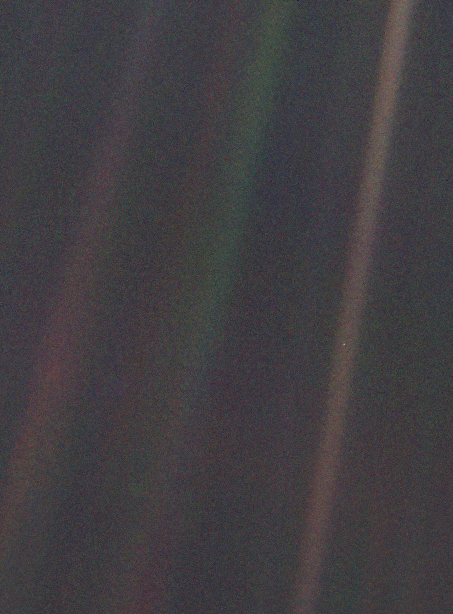
That’s here. That’s home. That’s us. On it, everyone you love, everyone you know, everyone you ever heard of, every human being who ever was, lived out their lives. The aggregate of our joy and suffering, thousands of confident religions, ideologies, and economic doctrines, every hunter and forager, every hero and coward, every creator and destroyer of civilization, every king and peasant, every young couple in love, every mother and father, hopeful child, inventor and explorer, every teacher of morals, every corrupt politician, every “superstar,” every “supreme leader,” every saint and sinner in the history of our species lived there — on a mote of dust suspended in a sunbeam.
The Earth is a very small stage in a vast cosmic arena. Think of the rivers of blood spilled by all those generals and emperors so that in glory and triumph they could become the momentary masters of a fraction of a dot. Think of the endless cruelties visited by the inhabitants of one corner of this pixel on the scarcely distinguishable inhabitants of some other corner, how frequent their misunderstandings, how eager they are to kill one another, how fervent their hatreds.
Our posturings, our imagined self-importance, the delusion that we have some privileged position in the Universe, are challenged by this point of pale light. Our planet is a lonely speck in the great enveloping cosmic dark. In our obscurity, in all this vastness, there is no hint that help will come from elsewhere to save us from ourselves.
The Earth is the only world known so far to harbour life. There is nowhere else, at least in the near future, to which our species could migrate. Visit, yes. Settle, not yet. Like it or not, for the moment, the Earth is where we make our stand.
It has been said that astronomy is a humbling and character-building experience. There is perhaps no better demonstration of the folly of human conceits than this distant image of our tiny world. To me, it underscores our responsibility to deal more kindly with one another, and to preserve and cherish the pale blue dot, the only home we’ve ever known.
— CARL SAGAN, Pale Blue Dot
Hydraulic fracturing or fracking involves accessing oil and natural gas deposits deep below the earth’s surface by injecting pressurised fluids into a horizontal bore. The fracking fluids create fractures or fissures in the crust and free the trapped oil or natural gas which can thereafter be extracted. The horizontal bore, which can extend laterally for 3,000 to 5,000 feet, provides a larger surface area for the escaping gas, and is one of the key innovations that have made this process economically feasible. The jury is still out on whether fracking has adverse environmental consequences. Proponents argue that if done carefully the technology can be used to access hitherto inaccessible deposits, thereby prolonging our addiction to oil. Critics point out that the fluids used in the mining process can contaminate groundwater resources and lay agricultural land barren. (This is an informative animation that I came across that explains the process in greater detail.) Although the technology was developed in the late 1940s, its use became commercially viable only recently. As of 2010, it is estimated that 60% of all new oil and natural gas wells were being hydraulically fractured. The New Oil Landscape places fracking in a broader socio-economic context, and proved to be quite insightful. It is the sum total of my knowledge on the subject. Needless to say, I am not aware of the academic debate surrounding the technology.
I also came across a movie — Promised Land — that portrays fracking in a negative light. It stars Matt Damon and Frances McDormand, both gifted actors. Initially quite excited by the questions raised (I always enjoy watching the evil plans of big corporate conglomerates being thwarted by ordinary people), my enthusiasm was somewhat subdued when I came to know about the controversy surrounding the financing of the movie. Apparently, it has been backed by some subsidiary of the Saudi Arabian oil cartel, which has vested interests in delaying the development of fracking (Most of the oil deposits in the Middle East are conventional ones which stand to gain if fracking proves to be environmentally disastrous). Although, the financier claims that the backing was provided regardless of subject matter or genre, one is forced to wonder. The movie itself is not spectacular and I watched it only because of aforementioned reasons.
Noted astrophysicist, cosmologist, and popular science author, Carl Sagan ends his book The Dragons of Eden with the following lines: “The universe is elegant and intricate. We wrest secrets from nature by the most unlikely routes”. Even though the subject matter of the book deals with his speculations on the evolution of human intelligence, this series of articles, should it manage to succeed in its aim, should serve the purpose of highlighting the veracity of his words. The fabric of the cosmos does present the human intellect with numerous challenges. As we unravel its umpteen layers, the excitement of having solved a mystery can be said to only marginally exceed the frustration at encountering new questions. In this mythical quest for secrets, as hope trumps disappointment, the cycle of discovery keeps reinventing itself as one puzzle replaces the next.

Mathematically, this evolution can be said to have two distinct stages. In the first stage, the probability wave of an electron (or some other fundamental particle) evolves over time – smoothly and gradually – according to Schrödinger’s equation. The second stage is when we make contact with the observable reality, causing the electron to snap to, let’s say, a particular position, thereby ‘collapsing’ the wavefunction. And therein lies the heart of our ‘problem’.
The quantum mechanical description of reality is clueless about this collapse. According to Schrödinger’s equation, wavefunctions do not collapse. It is simply a convenient add-on that helps theory agree with observations (I have come to believe physicists often do that). Since the cat is never observed to be both dead and alive, the explanation safely posits that the act of measurement causes the wavefunction to relinquish its state of quantum limbo and usher one of the possibilities into reality. But what is so special about the act of observation that causes this choice to be made? How are the different possibilities converted onto an actual, sharply-defined outcome? This dilemma is what’s known as the Quantum Measurement Problem and forms the core of several contending interpretations of QM that seek to explain what has so far only been observed.
Werner Heisenberg, who, along with Neils Bohr, formulated the Copenhagen interpretation, provides some particular useful insights regarding the nature of quantum reality in his book Physics and Philosophy. He writes, “Reality is in the observations, not in the electron.” This view is embodied in the Copenhagen interpretation which claims that a wavefunction is merely the mathematical embodiment of what we know about reality. Before we observe the electron, it exists in a ‘coherent superposition’ of all possible positions, snapping out of this haze when we measure its position. In this respect, the collapse is nothing more than the change in our knowledge about the whereabouts of the electron. What goes on behind the scenes, strictly speaking, lies beyond the scope of physics.
Crudely translated, this would imply that the cat is to be considered alive and dead at the same time! Naturally, this worldview, even though quite popular, does not sit well with a number of physicists and, yes, philosophers. Detractors question why fundamental physics should so closely be tied to human awareness. If we were not here to tinker around with laboratory equipment, would wavefunctions never collapse, or better still, not exist? Can bacteria or ants not be observers of quantum reality and a change in their ‘knowledge’ be associated with the wavefunction collapse?
For several years, the Copenhagen interpretation of QM held sway in scientific circles. But its primacy was challenged 1957 by an approach formulated by Hugh Everett that subjects our classical instinct to another major upheaval. (I seem to be getting into the habit of saying this. But, well.) The many-worlds interpretation (MWI) denies the occurrence of the wavefunction collapse. Instead, it views reality as a multi-branched tree, where each possible quantum outcome is realized. The concept of the universe is enlarged to include an infinite number of ‘parallel universes’ within a larger multiverse so that anything that can happen actually does happen in one of the innumerable versions of our universe. In one universe you are reading these words while in another you are waiting anxiously for the grand gala opening of your first play. It’s all happening out there!
Needless to say, I have only scarcely begun to realize the impact that this can have on our understanding of not only science but widely disparate disciplines like philosophy and spirituality. What if I were to put a gun to my head and pull the trigger? Would I be able to pull off this ‘quantum suicide’? If MWI is right, there will be a copy of our universe where I am alive and well. Should that mean my consciousness is, in essence, immortal? Quacks have been quick to jump on this bandwagon and have sought to use MWI to give credence to the idea of a soul that defies death and simply changes its ‘vessel’ as it hops from one universe to the next. Maybe that is how our ancestors tried to comprehend the strangeness of the universe we inhabit. Who knows!
But physicists are not in the business of mysticism and they have never really liked playing with odds. Some promising steps have been taken in the direction of separating spirituality from science through work on the phenomenon of ‘decoherence’. Decoherence provides an explanation for the appearance of the wavefunction collapse by postulating that much of the quantum weirdness of large objects ‘leaks’ from large objects because of their interaction with their environment. In other words, it is the framework which tries to explain how quantum uncertainty morphs into the well determined outcomes of classical experimental physics and our intuitive understanding of reality. MWI, with its decoherence updating, can prove to be an encouraging direction in the evolution of quantum theory.
Through the course of this debate, I have tried to emphasize how the resolution of one conundrum often leads to the genesis of a new one. When Newton tried to describe the ‘music of the spheres’, he could have scarcely imagined a world in which reality is neither deterministic nor viewed as a single unfolding history. Nevertheless, standing on the shoulders of such giants, we have been steadily hacking away at the myriad layers of our cosmic onion. As our intuition grapples with what is revealed to us, we will continue to reconsider our definitions truth and reality. The implications are exciting and manifold. But, as I will attempt to elaborate on in my next article, we must be careful enough to view them through the lens of reason and scientific analysis. One must sift through all the hoopla and take care to not be swept away by the wave. Doing so, we will realize that science does not undermine the beauty of the stars. Instead, it makes even larger the canvas of their mysticism. After all, it was Bohr who said, “Anyone who is not shocked by quantum theory has not understood it”.
Note: For the sake of simplicity (and to avoid making this article too tedious a read), I have discussed only two of the several contending interpretations of quantum mechanics. Interested readers can, obviously, choose to further this understanding. The following Wikipedia page should be a good starting point: http://en.wikipedia.org/wiki/Interpretations_of_quantum_mechanics.
Images from http://farside.ph.utexas.edu and http://en.wikipedia.org.
Physicists are an arrogant lot. And if Sheldon Cooper is any proof, they are usually quite happy being unapologetic about it. In an alternate universe, we probably pay our homage at the Cathedral of Science, with theoretical physicists presiding over as high priests. However, in our own version of the cosmos, I am willing to give them the benefit of a fertile imagination, given their knack of coming up with the weirdest explanations for everyday phenomenon. Therefore, it is a feast for the intellect when some of the brightest minds of a generation squabble over, quite literally, a dice.
Our classical sense of intuition tells us that in order to produce a change in a system (read ‘object’ if you are less scientifically minded) on the order side of a football field we will have to somehow negotiate the intervening space. That is what space does. We can shout, send a laser beam, or mail a postcard and wait for the cows to come home. Physicists and philosophers have a word for such a world view – local realism. Local realism posits that an objective reality exists even when it is not being observed and that an object can be influenced only by its immediate surroundings. It’s like what Winston Smith of 1984 would have us believe – “Sanity is not statistical”. Until the first two decades of the 20th century, no scientific development had challenged the locality of our universe. But all this was about to change.
The science of Quantum Mechanics (QM in all future references), developed primarily during the period between 1900 and 1930, breaks away completely with the tradition of a local, deterministic universe. It claims that one can not even know with certainty the position or velocity of a single particle, leave alone the evolution of the entire cosmos. Not only that, QM stipulates that prior to the act of measurement or observation, there is no point in even talking about such physical quantities. An electron could be here, in Andromeda Galaxy, or everywhere. Its behaviour can only be described by a fuzzy haze of probabilities, with no outcome being absolutely certain. Period. While relativity is counter-intuitive at best, QM is downright bizarre and malicious. It shatters our personal, individual conception of reality. God, it would seem, does like to play dice with the universe. And he rolls them blindfolded.
In order to interpret the physical properties of the micro-cosmos, QM uses a construct known as the ‘probability wave’. For example, if we are trying to study the position of an electron, the size of a wave at a given point in space is proportional to the probability that the electron is located at that point. But before the experiment is carried out and once its over, there is no way to determine for sure where it’ll be found. Identical experiments, performed under identical conditions, yield different results which agree with the probability profile of the electron’s probability wave. But is this wave thingamajig something real or just a convenient mathematical model that embodies all that we know and observe about the fundamental particles? Does quantum uncertainty tell us at that any moment particles simply do not possess a definite position?
This deconstruction of reality does not stop here. QM predicts the existence of ‘entangled’ particles that exist in a nebulous haze of uncertainty until one of them is forced to snap out of it when appropriately measured or interacted with. The outcome attained by any one of them is mirrored by each of the other entangled particles instantaneously, irrespective of the amount of space that separates them. If one decides to sport a pair of Ray Ban sunglasses, all the other entangled particles will choose to do so. They could be in two different corners of a room or at opposite ends of a galaxy – it doesn’t matter. This is dark magic or voodoo at its very best!
Naturally, this attack on the fundamental nature of reality did not sit well with Einstein. Over the course of many years, he mounted a series of ever more sophisticated challenges aimed at exposing the lacunae in quantum theory. He once reportedly said, “Do you really believe that the moon is not unless we are looking at it?” The stalwarts of QM were obviously not amused. So Einstein sought to provide a physical argument for this philosophical conundrum. In 1935, he published a paper with two of associates at Princeton – Podolsky and Rosen – which provided a theoretical basis for what has come to be known as the EPR Paradox. Using Heisenberg’s Uncertainty Principle, the authors argued that QM could not be a complete description of the physical reality and that a more fundamental theory is needed to understand it. For instance, it was argued ‘entangled’ particles displayed correlated properties simply because they had ‘hidden variables’ that programmed them to do so. Somewhat similar to two machines coming up with the same results even though they might be separated by a vast distance.
For several years the issue of who was right was left unresolved. Then in the 1960s, the Irish physicist John Bell showed that the debate could be settled experimentally. First in late 1980s and then later on through a series of progressively refined experiments, it has been proven conclusively that ‘spooky’ connections do exist between particles that defy our conventional notion of existence. What happens in Vegas doesn’t just stay there. Something like this should take your breath away! It affirms that a local universe may exist in our mind, but not in reality. What if our universe was nothing but a mirror image of an infinite number of entangled universes? As it is so poetically depicted in the movie Another Earth, is there the possibility that duplicate copies of our ‘selves’ exist? Would our choices mirror theirs?
The world according to the quantum is a strange place indeed. It forces us to abandon the idea of a local universe. It also throws out the window the notion of an objective reality – one that has always existed. The act of observation, hence, becomes closely intertwined with the process of creating the very reality that is being observed. In effect, this theory is incredibly efficient: it explains what you observe with mind boggling accuracy but prevents you from seeing the explanation. And therein lays the problem of reconciling our day to day experience of life with the weird microscopic reality revealed to us by quantum mechanics. Wasn’t life complicated enough to begin with?
Our society is structured according to the way we understand reality. Our definitions of truth, free will, justice are intricately tied to this understanding. To undermine its importance in the context of our own lives is to be deliberately short-sighted. And to ignore its implication, a fool’s paradise. So is that it? Is our reality merely a game of chance? Is Schrödinger’s cat really alive and dead at the same time? In my next article, I will try to dwell upon the different interpretations of quantum mechanics and what promises they hold for our understanding of that most elusive of phantoms – reality.
The first article in this series is available here: http://sleepingtablets.blogspot.com/2011/11/roads-to-reality-einstein-and-faith.html.
PS: If you are interested in the details of the arguments presented in the EPR Paradox, I suggest you read the original paper. It is not very long and Einstein's grouse with quantum theory has been expressed very succinctly. Here is the link to it - http://www.drchinese.com/David/EPR.pdf. Just ignore all the mathematics and concentrate on the parts mentioned on Page 1 and Page 4.
Image Courtesy: http://www.taleas.com/

PS — Somebody read this post and emailed me saying that this - http://www.internetservice.net/2011/10-things-that-einstein-might-have-tweeted/ - might be a fun addition to all the serious stuff here! I am inclined to agree : )
“There is but one truly philosophical problem, and that is suicide.” Thus begins Albert Camus’s seminal work in existential philosophy – The Myth of Sisyphus. The premise of the book is an ancient legend in which the Greek hero, Sisyphus, is eternally condemned to the task of pushing a rock up a mountain, knowing very well that it will roll back down. The million dollar question here – How does Sisyphus commit himself to a life without purpose, even bordering on the absurd? If his perception of reality were to change, would he see a silver lining? Camus acknowledges the significance of understanding the nature of the universe, but rejects the likelihood that such an understanding would effect our assessment of life’s worth. I beg to disagree.
It is true that reality is revealed to us through our experiences. But its arena is not just the world we inhabit. The overarching lesson from the past two centuries of scientific discovery is that our senses are often a misleading guide to the true nature of reality. In his book, The Fabric of the Cosmos, physicist Brian Greene aptly surmises this experience as – “gazing at a van Gogh through an empty Coke bottle”. Lying just beneath the surface of our perception is a world that will take our breath away. Through the tireless efforts of eccentric geniuses, mad scientists, and indefatigable innovators, we have been able to peel away layer after layer of this beautiful reality and come one step closer to understanding it. I feel that any assessment of existence that fails to incorporate the insights provided by modern science is not only incomplete but also juvenile.
Few scientists or their discoveries have achieved such ubiquity as Albert Einstein and his Theory of Relativity – with perhaps the notable exception of Sir Isaac Newton. A downside of such fame was that his statements and remarks were often blown out of proportion. So when Einstein claimed that he was religious, religious leaders latched onto his words and sought to use them in order to sanction their brand of God Almighty. But there is a quote that is frequently attributed to the great physicist – “Make everything as simple as possible, but not simpler”. Wary of being quoted out of context, he sought to express himself clearly on the subject, both for himself and for the sake of those who wanted a simple answer from him. So in the summer of 1930 he composed a credo – ‘What I Believe’ – that he released to a human rights group and later on published.
Throughout his life, Einstein maintained that underneath all the discernible laws of physics, there is a mysterious force, subtle and intangible, that is responsible for the harmony that we see around us. Veneration for this enigmatic power constituted his religion. He wrote, “To sense that behind anything that can be experienced there is something that our minds cannot grasp, whose beauty and sublimity reaches us only indirectly: this is religiousness. In this sense, and in this sense only, I am a devoutly religious man.” The mandate of science, according to him, was to hack away at this mystery and reveal to us those fundamental laws of nature that governed the ‘music of the spheres’. He gave no weight to the idea of a personal God who could meddle at whim in the affairs or mortal men.
A natural conclusion from this world view was Einstein’s belief in causal determinism. The world obeyed laws and we are just as bound to them as the planets that revolve around the stars. Were the immutable rules of nature revealed to us, it would be possible to predict with certainty if it will rain tomorrow at 4.15 in the afternoon and whether Mr. Sharma, a government clerk working in Jhumri Tilaiya, will choose to vaccinate his third child. Obviously, this was incompatible with the notion of free will, the very basis of moral behaviour and ethical freedom, and outraged several of his fellow physicists, including Max Born, who looked upon a deterministic world as downright ‘abhorrent’.
But that did little to dissuade Einstein. He famously quoted Schopenhauer in his credo – “A man can do as he wills, but not will as he wills”. Free will, in his view, was nothing more than a convenient construct that allowed civilised society to exist. Something that allowed people to rise above the ‘merely personal’ and live in a way that benefited humanity. “I know that philosophically a murderer is not responsible for his crime,” he said, “but I prefer not to take tea with him.”
In light of the groundbreaking success that his theories have had over the last 100 years, I found it a bit difficult to digest the notion that someone like Einstein could be religious. In fact, he was more critical of the fanatical atheists who “lacked utter humility toward the unattainable secrets of the harmony of the cosmos”. But that is when his words came to the rescue. Einstein believed that only a person thoroughly imbued with an aspiration for truth and understanding can do science. The source for that inspiration, however, lies in the sphere of religion. In other words (or more precisely, in his words), “science without religion is lame, religion without science is blind”.
But there was one religious concept that he could not accept. The bone of contention between religion and science, Einstein argued, lay in the concept of a personal God – someone who could randomly alter the course of events once they have been set into motion. A scientist on the quest for discovering the laws of reality must reject the notion that divine will, or for that matter human will, can influence this cosmic causality.
But even during the course of his life, a new sun was looming on the horizon of modern science. Few discoveries have so drastically affected our understanding of the machinations of the universe in recent times. Quantum Mechanics and the uncertainty woven into its fabric was about to deliver a knockout punch to the idea of a deterministic world. Deeply troubled by this assault on the very nature of reality, Einstein mounted a series of attacks against this emerging field in his later years. Physicists, he would emphasise, are not bookies and physics is not in the business of determining odds. Did he succeed in his mission or has our understanding been subjected to yet another upheaval? What implications does Quantum Mechanics have for our grasp over reality? More importantly, is this the only reality that exists? I will try to elaborate on some of these questions in the next article in this series.
Where does one start when one undertakes the phenomenal task of philosophising about such fundamental questions as the origins of life and the nature of time itself? Should one commence at the beginning of time? The apocalyptic or dystopian end of life as we know it? Or does one appreciate the insignificance of human existence on the cosmic timescale and refrain from making any assumptions whatsoever? Over the course of the last few months, I have been prodded, stimulated, and occasionally distracted from the ‘real’ problems of the world by some of my readings on these subjects. I concluded, perhaps presumptuously, that it would be a learning experience, if nothing else, to give some semblance of an order to what have been up till now just wispy strings of thoughts. That is all.
Explaining, says Richard Dawkins, is a difficult art. You can explain so that the reader understands your words; and you can explain so that he feels the essence of what is being conveyed. This article, though, aims for no such lofty ideal for its subject matter is, quite literally, too vast. What I do wish to attempt, however, is to at least hint at the complete picture and impress upon you the sublimity of it. This endeavour, I should warn you, just skims off the tip of the iceberg. Maybe not even that! But, hopefully, it will sufficiently pique your curiosity and prompt you to pursue one or several of the avenues that might open up. I do not make any claim as to the originality of the ideas mentioned here; indeed most of the conclusions have been drawn from articles and books by people far more admirably placed than me along the ‘imaginary’ axis of intelligence. It goes without saying, however, that any factual errors are entirely my own.
There are more things in heaven and earth, Horatio,
Than are dreamt of in your philosophy.
— Hamlet, Act I, Scene 5
Like God, people have the tendency to take time for granted. After all, it has existed as far back as anyone can tell. Not surprisingly, it is rather difficult to accept the fact that prior to a certain moment in time, there was nothing. No atoms. No laws of physics. Not even time itself. Modern cosmology stipulates that this momentous event – The Big Bang – happened about 14 billion years ago and most physicists now take this to be a given. At this time, all the matter in the universe was on top itself, forming a ‘singularity’ of infinite density. More importantly, what this means is that the state of the universe after the Big Bang would not depend on anything that happened before since all the deterministic laws would have broken down during the Big Bang. Events before the Big Bang are not defined because there is no way to establish what could have happened then. This kind of beginning to the universe, and consequently time, has the downside of needing an external agency to kick-start it. (No wonder that despite tremendous strides in scientific achievement, we still have creationist hypotheses not only being believed in but also fostering controversy and superstition.) Since this wasn’t such a scientifically sound premise, several theories were proposed in the past to get around the conclusion that universe was once not reduced to a singularity. I have taken the liberty of discussing one of them here.
The Steady State Theory (1948) by Fred Hoyle, Thomas Gold, and Hermann Bondi proposed that matter is constantly being created so that the density of the universe remains constant over time. The theory asserts that the universe is constantly expanding but it does not change its appearance over space and time. This principle – also known as the Perfect Cosmological Principle – essentially means that the universe has always been there, with no definite beginning or end. However, the discovery of microwave background radiation in 1965 proved to be a death blow for the Steady State Theory as there was no way it could be satisfactorily explained by the tenets of the hypothesis. The steady state model was therefore discredited by the scientific community and it is now agreed that the Big Bang Theory is the most accurate explanation for the origin of the universe; one that is supported by scientific evidence and experimental observations. (Life, it seems, is not without a sense of irony. It was Fred Hoyle who first came up with the term Big Bang during a radio broadcast in 1949 and what came to be known as the Big Bang Theory originated from ideas originally proposed by Monsignor Georges Lemaître, a Belgian priest of the Roman Catholic Church).
The Big Bang Theory relies on General Relativity to extrapolate the expansion of the universe backwards in time, yielding a singularity of infinite mass and density at a finite time in the past. However, beyond this point, general relativity (and all other physical laws) breaks down. Big Bang Theory can not and does not provide an explanation for such a state of the universe. It only seeks to describe the events that happened after it. Indeed, there is a limit up till which the extrapolation described above is even theoretically possible. This limit – known as the Planck Epoch – is the shortest possible unit of time and represents the period during which the fundamental forces of nature were possibly unified. A new quantum theory of gravitation – scientific models that unify quantum mechanics with general relativity – is needed to break this theoretical barrier and understanding this earliest era in the history of the universe remains one of the greatest unsolved problems in physics. So who would up the clock work for the first time? What caused the Big Bang? God?
Some of the recent work by physicists Stephen Hawking and James Hartle has tried to do away with the idea of singularities altogether by introducing the notion of ‘imaginary’ time. It suggests that space and imaginary time together are fixed in extent but without a boundary, similar to the surface of the Earth which is finite but without any edges. (Try imagining a four dimensional curved space with three axes in space and one along imaginary time). The no boundary proposal maintains that the laws of physics hold everywhere, in imaginary time, which implies that the state of the universe can be uniquely determined at any instant in imaginary time. But if one can calculate the state of the universe in imaginary time one can do so in real time as well. If they are right, the universe still started from a single point in real time, the reasons being determined by its corresponding state in imaginary time, and thereby has a definite age to it. But this point wasn’t a singularity and it expanded uniformly by borrowing energy from the gravitational field to create matter. The concept of imaginary time and extra dimensions might seem straight out of a sci-fi novel that talks of wormholes or hyperdrives. But not a very long time ago, even submarines were science fiction. Interestingly enough, some of the predictions of the Hartle-Hawking no boundary state are consistent with observation but it remains to be seen whether it can stand the test of – you guessed it right – Time.
Once the universe started expanding and the laws of physics came into existence in their present form, it was a only matter of time (actually, somewhat like 200 million years) before slightly denser regions of nearly uniformly distributed matter gravitationally attracted nearby matter, thereby forming stars, galaxies, gas clouds, and other celestial structures observable today. The earliest Solar System material was formed around 4.56 billion years ago and within 10-20 million years, Earth and other planets of the solar system had formed out of the disk shaped mass of gas and dust left over after the formation of the Sun. Initially molten, the outer layer of Earth cooled to form a solid crust once water started accumulating in the atmosphere. According to the best available estimates, life appeared on Earth within 1 billion years of its formation. This brings us to the second important question – how did life originate?
[Here I would like to point out that I am intentionally skipping out on the discussion on Fermi’s Paradox – the apparent contradiction between high estimates of the probability of the existence of extraterrestrial civilizations and the lack of evidence for, or contact with, such civilizations. There are about 100 billion billion planets out there which are roughly suitable and as noted astrophysicist Carl Sagan aptly surmised, it is an awful waste of space if we are alone. Even so, I will try to briefly broach this subject later.]
Before life begins and evolves into anything complex, one must seek to answer the more elementary question – what does it take to be alive? What minimum requirements must one meet in order to nourish life? Atoms can move, change their form, and do all sorts of callisthenics. Would you consider them alive? In his excellent book The Blind Watchmaker, Rickard Dawkins explains that there are three properties necessary for life to sustain and, more importantly, renew itself through the processes of ‘natural selection’ – replicability, mutations or errors in replication, and the power to exercise influence over the process of its own replication. There must come into existence, through the laws of physics, these self-copying entities or “replicators”. The very first replicators were probably not DNA molecules for they are far too complex to have arisen spontaneously – the odds against such an event happening are astronomical; even the life of the universe is not enough. They were cruder, simpler versions of DNA molecules that used even simpler building blocks present in their environs to churn out copies of themselves.
So we have these replicators going at it like rabbits. Each progeny is exactly the same as its ancestor and continues to behave in the same manner. In a perfect world, where the supply of raw materials is infinite, this population of molecules would have grown indefinitely. However, that is never the case; which underlines the significance of the other two properties. Occasionally, as should be expected, errors in duplication occur that produce an ‘offspring’ molecule that is either better suited or ill equipped to face its environment. In case of the former, it becomes more adept at the game of survival and is able ‘live’ long enough to pass on the errors it inherited to successive generations of daughter molecules which slowly outnumber the original ancestor type as the struggle for resources heats up. The forces of natural selection weed out any of the ‘weaker’ molecules in this colony, thereby producing increasingly sophisticated descendants that are better adapted to survive in their environment and which evolve over the course of millions of generations into complex life forms. But how did these replicators come into existence? What were the first entities that possessed these properties?
There is no magical wind that breathes life into mere bones and flesh, even if that is what the Book of Genesis or other religious scriptures would have us believe. (Had Darwin lived in the medieval ages, he would have probably been the focus of a massive inquisition, subjected to some pretty humiliating ridicule, and then subsequently burnt at the stake.) So there must be a rational explanation for the first ‘living’ compounds. The family of theories which holds favour with a majority of the scientific community is based on an organic primordial ‘soup’. It presumes that ancient earth had an atmosphere composed primarily of gases like methane, ammonia, carbon dioxide, and water vapour, with a bolt of lightning thrown in for fun – the Miller-Urey Experiment for the more scientific minded. Long story short, this particular hypothesis claims that the simplest forms of self-replicating molecules came together in this primeval soup in the form of simple organic compounds like amino acids and then evolved into better and bigger things – namely the RNA/DNA/protein genetic machinery.
Another interesting school of thought, which I have chosen to discuss here and which gained ground during the 1980s, was proposed by Graham Cairns-Smith. Known as the Clay Theory or the inorganic mineral theory, Cairns-Smith’s view of the DNA/RNA/protein machinery is that it came into existence relatively recently, about 3 billion years ago, after usurping a function that was previously served by self replicating inorganic crystals like the silicates. Once this happened, DNA proved to be so efficient in storing and reproducing genetic information that the original system was cast aside. This conjecture gains credence when you consider the fact that the initial process of replication should have been crude enough to come into existence by ‘chance’ or single-step selection. Now, in crystalline form, atoms or molecules have the tendency to slot together in a particular fashion because of the stability such an arrangement. The same atoms may choose to crystallise into more than one type of configuration. Every part of this crystal is exactly the same as another – endless rows of atoms extending in every direction. So far so good. But how about reproduction mechanisms? Mutations, errors, and consequent adaptation or extinction?
[Here I must impress upon you the importance of reproduction for all life forms; more vital than the capacity to survive is the ability to reproduce because that is the single most important factor ensuring the continuance of the collective genetic pool. It would seem counter-intuitive but we exist for the benefit of genes rather than the other way around. We are nothing more than mules relaying this genetic information from one generation to another. Genes first came together in cooperative structures, like a living organism, just so that the community could prove to be beneficial for all the constituent genes. Otherwise, they would still be competing replicators in the primordial soup.]
Coming back to the crystals, atoms or ions floating around freely in solution have a tendency join the layers of atoms on the surface of a crystal that is introduced into the solution – a process known as seeding. They simply latch onto the existing structure and keep on adding layers to it. Crystals have also been known to form spontaneously in super-saturated solutions; but that is not very relevant to this argument. What’s more important is that when they these atoms/ions do crystallise, microscopic flaws may appear in the structure of the crystal – a layer cleaved in half or inclined to other layers at an angle. As the crystal grows, it sometimes snaps under the strain (such parameters for a particular arrangement would be governed by physical laws), thereby spawning a generation of daughter crystals. The properties and flaws of the ancestral crystal type are preserved in successive generations unless there is another accidental mistake in crystal growth – in other words, mutations. If one type has a greater tendency to ‘bend and break,’ we would have a very simple version of natural selection going – the solution would exhibit progressively higher concentrations of the ‘fitter’ crystal, the one with the shorter reproductive cycle.
Masses of clay crystals of a particular form might also have the power to exert influence over their external environment in order to improve the chances of further replication. For example, a ‘stickier’ variety of clay is likely to cause sedimentation in a river bed, creating an environment conducive for crystallisation from the silt. By damming, it might even manipulate flow of the stream, thereby extending its influence to other previously ‘uninfected’ territories. Some crystals might make conditions hard for ‘rival’ crystals that compete for raw materials while some might become ‘predatory’ by breaking up their competitors and using their elements as building blocks. The possibilities seem endless once natural selection is set on its course! The clay does not ‘want’ to continue existing but these are just incidental consequences of the properties inherent in the crystal. Imagine the poor crystals pondering over existential questions like us!
As these simple replicators become more and more complicated, they devise tools – catalysts, blueprints etc – that assist in their reproductive process. Organic compounds have often been closely associated as catalysts in synthesis of inorganic compounds. Even champions of the primordial soup hypothesis concede that inorganic compounds were vital to some of the organic reactions that led to the origin of life. So we can very well turn the argument on its head, take a leap of faith, and speculate that the first proteins and nucleic acids like RNA were actually synthesised by the complex clay replicators for their own purposes. The fact that this doesn’t seem so incredible is why I feel this audacious theory may be right! The final act in this elaborate ‘tragedy’ is staged when these very tools affect a “Genetic Takeover” from their clay vehicle, becoming an independent modus operandi for reproduction; a means that proved to be so successful that it has continued till date. But, have you ever asked of yourself, for how long?
The process of biological evolution proceeded at a snail’s pace at first. It took billions of years to evolve from the earliest single celled animals to multi-cellular organisms but it took only a fraction of that time for prehistoric mammals to evolve into humans. And there are not a whole a lot of aeons separating us from the apes. With the human race, evolution seems to have reached a critical stage, comparable in significance to the DNA. Development of language and modern modes of communication means that the amount of information can be passed down from one generation to another, non-genetically, is growing exponentially. And that is not just meant as a figure of speech. Over the ten thousand years of recorded history, there has not been perceptible change in the genetic map of humans – a few million bit errors at most. However, millions of new books are being written every year that add to the collective information database of our species. We might as well go out on a limb here and say that this amounts to a new phase in our evolution, one that proceeds not by altering the information stored in the genes but through “external transmission”. What this means is that though we might not be any brighter or inherently stronger than our cave dwelling ancestors, we differ from them because of the vast reservoir of knowledge at our disposal. A reservoir which we are ill-equipped to utilise efficiently and which more often than not is influenced by our primitive aggressive instincts, referred to as Thanatos or the death drive in post-Freudian literature. What could earlier be passed off as loss of land or conquest of women folk might now result in a nuclear winter.
It is easy to argue that feats of modern science like genetic engineering might allow humans to overcome restrictions like intelligence, the death drive, and even mortality. But that very argument should force us to consider the nature of life that will succeed ours. If the humans do not succeed in killing each other, they will eventually run out of resources here. Since interstellar travel is no longer a figment of our imagination, we might even have NASA launching missions to colonise planetary systems in other galaxies through DNA stored in cryogenic capsules. But nothing travels faster than the speed of light and even the distances in the observable universe are astronomical. The sheer numbers involved suggest that humans will have to resort to machines in order to implement the inter-galactic version of neo-imperialism. With the amount of intelligence required by the machines to be imbued with in order to undertake such explorations, it is not very incredulous to foresee a future where sentient mechanical beings will take over the mantle of evolution from human beings. After all, life does not need us to sustain itself. We could very well have machines capable of reproduction and self-design, thereby meeting all the requirements necessary to be considered alive. If this seems fantastic it is only because our brains have been built by natural selection to assess risks and probabilities that are commensurate with our lifetimes of a few decades. Not the geological or astronomical timeline that seems to extend forever in both directions.
During our space travels, we (or the sentient machines) might get to meet some exotic alien civilisation. But given the fact that our scientific reasoning has not misled us so far and that God has not been playing dice in other parts of the universe, the chances of that happening are low. Here’s why. We have seen that it takes billions of years for life to evolve intelligence and it is only ONE of the several possible outcomes. Moreover, life does not need intelligence to survive. There are millions of bacteria living in the most inhospitable of conditions and they seem to be doing just fine. They were here when we weren’t and they probably will be long after we are gone or until the Sun swells up into a red giant and swallows everything from Mercury to Mars. As if that were not enough, it is a minor miracle that our beloved mammals weren’t wiped off the face of the Earth by a comet or gigantic meteorites while they were mating copiously and furiously contributing to the gene pool. Space is huge. Extra-terrestrial collisions keep happening all the time and 5 billion years is a long time to mess around with the odds. Dinosaurs learnt it the hard way and so might we. (The comet Shoemaker-Levy put a huge dent in Jupiter and that is when Jupiter’s is 11 times the size of Earth and has 64 satellites and its ice rings serving as gargantuan guards). Even if these insane odds were to be ignored, intelligence does not seem to have any long-term survival value. Humans have enjoyed killing not just each other but everything around them as well. What is to stop the aliens from dying as well as a consequence of their own stupidity?
All things said and done, it is indeed a feat of Nature that we exist and possess the faculties which allow us pose and debate questions like these in the first place. That fact can not be denied and should only inspire awe. If it took life the better part of the last 3.5 billion years to evolve into such organised complexity, it is because it is so beautiful. If we do not have answers to some of the questions, it is because Big Science and modern cosmogony are the areas where reason and religion often fight for breathing space. However, at the end of the day, one must get one’s sleep. So in light of all this nonsense, it doesn’t seem too imprudent to ignore the harsh, mind-numbing realities of science and deliberate over some existential questions, now does it? I will leave you to it; it has already been to much of a mind-fuck. So long, and thanks for all the fish.
Articles/Books which elaborate on the ideas mentioned here:
A Brief History of Time by Stephen hawking, published 1988.
Clay Theory on the Origin of Life: http://originoflife.net/
Fermi’s Paradox: http://abyss.uoregon.edu/~js/cosmo/lectures/lec28.html
Life in the Universe: http://hawking.org.uk/index.php?option=com_content&view=article&id=65
Miller/Urey Experiment: http://www.chem.duke.edu/~jds/cruise_chem/Exobiology/miller.html
Public Lectures by Stephen Hawking: http://www.hawking.org.uk/index.php/lectures/publiclectures
The Blind Watchmaker by Richard Dawkins, published 1986.
Image Courtesy: Saturday Morning Breakfast Cereal


