


Take your heart and twist it in places you did not know existed.
Wednesday, March 09, 2016
Monday, March 07, 2016
Guru Purnima
Dear Guruji,
A lesson from my school days that has stayed with me through all these years is one I associate with my high school Physics teacher. He used to keep reiterating that the purpose of education is not to make one learned, but to make one humble. The more educated one is, the more one comes to recognise humility as a virtue. In the capacity I know you, I realise that you illustrate this message remarkably well and, through your example, I have come to understand its significance in the context of my own life.
However, the most important lesson I have learnt from you is that one must be kind, both in spirit and in actions, towards others, especially towards people who have no reason to expect such goodwill. It doesn’t matter what one’s designation is or how much money one makes, it is immaterial what accomplishments one has or what one’s status in society is – benevolence knows no arrogance and therein lies its beauty. The prince and the pauper can both practice it equally well.
Even in such dark and depressing times like these, though your help I have discovered that gentleness of the soul has the capacity to make decent human beings out of us. You have been instrumental in helping me realise that when we are gone, compassion grants us far greater longevity than our accomplishments. Moreover, kindness is as much about others as it is about oneself. One needs to be kind to be able to forgive oneself and overcome the trauma of past mistakes and failures.
For a long time now, I have kept telling myself that it is essential to do well in life, but it is more important to do good. Your actions and character drive home the point that I was correct in assuming so. For that, thank you. My only hope is that I am able to practice these lessons in life just as well as you for the best teacher is not the one who leads by instruction, but the one who does so by example.
I hope to continue learning from you for many more years to come.
Yours truly,
Siddhartha.
A lesson from my school days that has stayed with me through all these years is one I associate with my high school Physics teacher. He used to keep reiterating that the purpose of education is not to make one learned, but to make one humble. The more educated one is, the more one comes to recognise humility as a virtue. In the capacity I know you, I realise that you illustrate this message remarkably well and, through your example, I have come to understand its significance in the context of my own life.
However, the most important lesson I have learnt from you is that one must be kind, both in spirit and in actions, towards others, especially towards people who have no reason to expect such goodwill. It doesn’t matter what one’s designation is or how much money one makes, it is immaterial what accomplishments one has or what one’s status in society is – benevolence knows no arrogance and therein lies its beauty. The prince and the pauper can both practice it equally well.
Even in such dark and depressing times like these, though your help I have discovered that gentleness of the soul has the capacity to make decent human beings out of us. You have been instrumental in helping me realise that when we are gone, compassion grants us far greater longevity than our accomplishments. Moreover, kindness is as much about others as it is about oneself. One needs to be kind to be able to forgive oneself and overcome the trauma of past mistakes and failures.
For a long time now, I have kept telling myself that it is essential to do well in life, but it is more important to do good. Your actions and character drive home the point that I was correct in assuming so. For that, thank you. My only hope is that I am able to practice these lessons in life just as well as you for the best teacher is not the one who leads by instruction, but the one who does so by example.
I hope to continue learning from you for many more years to come.
Yours truly,
Siddhartha.

Saturday, April 11, 2015
Come, pierce my shell.
To people who take pride in being alone: This story/poem from David Rakoff’s book Love, Dishonor, Marry, Die, Cherish, Perish: A Novel (2013) first appeared on This American Life’s “Frenemies” episode (#389, originally aired on September 11, 2009). It is one of the better ‘we all need the eggs’ kind of take on relationships that I have come across. Like with everything else ‘radio’, it’s even better if you listen to David recite it. It is a bit lengthy, I must confess, but in the age of the internet, when most of us have the attention spans of a tsetse fly, allow yourself this luxury, lest you forgot how to stand still and stay strong.
Nathan, at one of the outlying tables,
His feet tangled up in the disc jockey’s cables,
Surveyed the room, as unseen as a ghost,
While he mulled over what he might say for his toast.
Though the couple had asked him for this benediction,
It seemed at odds with them parking him here by the kitchen.
That he’d shown up at all was still a surprise.
And not just to him; it was there in the eyes
Of the guests who’d seen a mirage and drew near
And then covered their shock with a “Nathan! You’re here!”
And then silence. They’d nothing to say beyond that.
A few of the braver souls lingered to chat.
They all knew. It was neither a secret nor mystery
That he and the couple had quite an odd history.
Their bonds were a tangle of friendship and sex.
Josh, his best pal once. And Patty, his ex.
For a while he could barely go out in the city
Without a being a punchline or object of pity.
‘Poor Nathan’ had virtually become his new name,
And so he showed up just to show he was game
Though his invite was late, a forgotten addendum.
For Nathan there could be no more clear referendum
That he need but endure through this evening and then
He would likely not see Josh and Patty again.
Josh’s sister was speaking. A princess in peach.
Nathan dug in his pocket to study his speech.
He’d poured over Bartlett’s for couplets to filch.
He’d stayed up until three, still came up with zilch.
Except for instructions he’d underscored twice.
Just two words in length, and those words were ‘be nice’.
Too often, he thought, our emotions betray us
And reason departs once we’re up on the dais.
He’d witnessed uncomfortable moments where others had lost their way quickly,
Where sisters and brothers had gotten too prickly
And peppered their babbling with stories of benders,
Or lesbian dabbling or spot-on impressions of mothers-in-law.
Which true, Nathan thought, always garnered guffaws
But the price seemed too high with the laugh seldom cloaking
Hostility masquerading as joking.
No, he’d swallow his rage and he’d bank all his fire.
He knew that in his case the bar was set higher.
Folks were just waiting for him to erupt.
They’d be hungry for blood even though they had supped.
They’d want tears or some other unsightly reaction.
And Nathan would not give them that satisfaction.
Though Patty a harlot and Josh was a lout,
At least Nathan knew what he’d not talk about.
I won’t wish them divorce, that they wither and sicken
Or tonight that they choke on their salmon or chicken.
I won’t mention that time when the cottage lost power
In that storm on the Cape and they left for an hour
And they thought it was just the cleverest ruse
To pretend it took that long to switch out the fuse.
Or that time Josh advised me with so much insistence
That I should grant Patty a little more distance,
That the worst I could do was hamper and crowd her,
That if Patty felt stifled she’d just take a powder,
That a plant needs its space just as much as its water,
And I shouldn’t give Patty that ring that I’d bought her,
Which in retrospect only elicits a “Gosh,
I hardly deserved a friend like you, Josh.”
No, I won’t spill those beans or make myself foolish
To satisfy appetites venal and ghoulish.
I will not be the blot on this hellish affair.
And with that, Nathan pushed out and rose from his chair.
And just by the tapping of knife against crystal,
All eyes turned his way, like he’d fired off a pistol.
“Ahem, Joshua, Patricia, dear family and friends,
A few words, if you will, before everything ends.
You’ve promised to honor, to love and obey,
We’ve quaffed our champagne and been cleansed by sorbet,
All in endorsement of your hers-and-his-dom.
So now let me add my two cents’ worth of wisdom.
I was wracking my brain sitting here at this table
Until I remembered this suitable fable
That gets at a truth, though it may well distort us
So here with the tale of the scorpion and tortoise.
The scorpion was hamstrung, his tail all aquiver.
Just how would he manage to get ‘cross the river?
‘The water’s so deep,’ he observed with a sigh,
Which pricked at the ears of the tortoise nearby.
‘Well, why don’t you swim?’ asked the slow-moving fellow.
‘Unless you’re afraid. I mean, what are you, yellow?’
‘It isn’t a matter of fear or of whim,’
Said the scorpion. ‘But that I don’t know how to swim.’
‘Ah, forgive me. I didn’t mean to be glib
When I said that I figured you were an amphib-
ian.’ ‘No offense taken,’ the scorpion replied.
‘But how ‘bout you help me to reach the far side?
You swim like a dream and you have what I lack.
What say you take me across on your back?’
‘I’m really not sure that’s the best thing to do,’
Said the tortoise. ‘Now that I see that it’s you.
You’ve a less than ideal reputation preceding.
There’s talk of your victims all poisoned and bleeding.
You’re the scorpion. And, how can I say this but, well,
I just don’t feel safe with you riding my shell.’
The scorpion replied, ‘What would killing you prove?
We’d both drown. So tell me how would that behoove
Me to basically die at my very own hand,
When all I desire is to be on dry land?’
The tortoise considered the scorpion’s defense.
When he gave it some thought it made perfect sense.
The niggling voice in his mind he ignored
And he swam to the bank and called out, ‘Climb aboard.’
But just a few moments from when they set sail,
The scorpion lashed out with his venomous tail.
The tortoise too late understood that he’d blundered
When he felt his flesh stabbed and his carapace sundered.
As he fought for his life he said, ‘Tell me why
You have done this? For we now will surely both die.’
‘I don’t know!’ cried the scorpion. ‘You never should trust
A creature like me because poison I must.
I’d claim some remorse or at least some compunction,
But I just can’t help it. My form is my function.
You thought I’d behave like my cousin the crab,
But unlike him, it is but my nature to stab.’
The tortoise expired with one final quiver,
And then both of them sank, swallowed up by the river.
The tortoise was wrong to ignore all his doubts
Because in the end, friends, our natures will out.”
Nathan paused, cleared his throat, took a sip of his drink.
He needed these extra few seconds to think.
The room had gone frosty; the tension was growing.
Folks wondered precisely where Nathan was going.
The prospects of skirting fiasco seemed dim,
But what he said next surprised even him.
“So, what can we learn from their watery ends?
Is there some lesson on how to be friends?
I think what it means is that central to living
A life that is good, is a life that’s forgiving.
We’re creatures of contact, regardless of whether
We kiss or we wound, still, we must come together.
Though it may spell destruction, we still ask for more
Since it beats staying dry but so lonely on shore.
So, we make ourselves open while knowing full well
It’s essentially saying, ‘Please, come pierce my shell.’”
Silence doesn’t paint the depth of quiet in that room.
There was no clinking stemware toasting to the bride or groom.
You could’ve heard a petal as it landed on the floor.
And in that stillness Nathan turned and walked right out the door.
— DAVID RAKOFF, Love, Dishonor, Marry, Die, Cherish, Perish: A Novel

Wednesday, September 03, 2014
Black Magic, woman.

Thursday, August 14, 2014
To the Poem
To the umpteen lives lived in quiet desperation.
To the days seized at the behest of unknown poets.
To the Captains in our lives.
To the emphatic poems they inspire.

To the days seized at the behest of unknown poets.
To the Captains in our lives.
To the emphatic poems they inspire.
O Captain! my Captain!
O Captain! my Captain! our fearful trip is done;
The ship has weather’d every rack, the prize we sought is won;
The port is near, the bells I hear, the people all exulting,
While follow eyes the steady keel, the vessel grim and daring:
But O heart! heart! heart!
O the bleeding drops of red,
Where on the deck my Captain lies,
Fallen cold and dead.
O Captain! my Captain! rise up and hear the bells;
Rise up—for you the flag is flung—for you the bugle trills;
For you bouquets and ribbon’d wreaths—for you the shores a-crowding;
For you they call, the swaying mass, their eager faces turning;
Here Captain! dear father!
This arm beneath your head;
It is some dream that on the deck,
You’ve fallen cold and dead.
My Captain does not answer, his lips are pale and still;
My father does not feel my arm, he has no pulse nor will;
The ship is anchor’d safe and sound, its voyage closed and done;
From fearful trip, the victor ship, comes in with object won;
Exult, O shores! and ring, O bells!
But I, with mournful tread,
Walk the deck my Captain lies,
Fallen cold and dead.
___

Tuesday, June 10, 2014
Pale Blue Dot
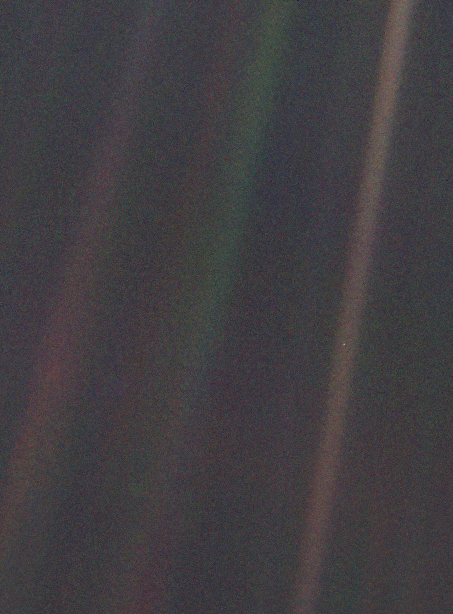
That’s here. That’s home. That’s us. On it, everyone you love, everyone you know, everyone you ever heard of, every human being who ever was, lived out their lives. The aggregate of our joy and suffering, thousands of confident religions, ideologies, and economic doctrines, every hunter and forager, every hero and coward, every creator and destroyer of civilization, every king and peasant, every young couple in love, every mother and father, hopeful child, inventor and explorer, every teacher of morals, every corrupt politician, every “superstar,” every “supreme leader,” every saint and sinner in the history of our species lived there — on a mote of dust suspended in a sunbeam.
The Earth is a very small stage in a vast cosmic arena. Think of the rivers of blood spilled by all those generals and emperors so that in glory and triumph they could become the momentary masters of a fraction of a dot. Think of the endless cruelties visited by the inhabitants of one corner of this pixel on the scarcely distinguishable inhabitants of some other corner, how frequent their misunderstandings, how eager they are to kill one another, how fervent their hatreds.
Our posturings, our imagined self-importance, the delusion that we have some privileged position in the Universe, are challenged by this point of pale light. Our planet is a lonely speck in the great enveloping cosmic dark. In our obscurity, in all this vastness, there is no hint that help will come from elsewhere to save us from ourselves.
The Earth is the only world known so far to harbour life. There is nowhere else, at least in the near future, to which our species could migrate. Visit, yes. Settle, not yet. Like it or not, for the moment, the Earth is where we make our stand.
It has been said that astronomy is a humbling and character-building experience. There is perhaps no better demonstration of the folly of human conceits than this distant image of our tiny world. To me, it underscores our responsibility to deal more kindly with one another, and to preserve and cherish the pale blue dot, the only home we’ve ever known.
— CARL SAGAN, Pale Blue Dot
Subscribe to:
Posts (Atom)


